Plant care · 13 min read
Houseplant humidity and central heating - why winter air dries plants, and what helps
Heating warms the air without adding any moisture, so indoor humidity can fall below 30% through winter. Why that crisps tropical leaves, which fixes the extension services say work, and why misting isn't one of them.
Botanical Legacy · Field notes ·
The radiator adds no dryness to the room. It adds heat, and the heat makes the air thirsty.
Heating dries the air without taking anything out of it
Relative humidity, the percentage on a hygrometer, is not a count of how much water is in the air. It measures that water against how much the air could hold at its temperature. The US National Weather Service puts the rule plainly: warm air can hold more water vapour than cold air, so the same air has a lower relative humidity when it is warmer. Heat a room and nothing leaves it, but the reading falls.
Winter does this twice. Penn State Extension notes that cold outdoor air holds little moisture to begin with, and heating it lowers the humidity further. Its figure for the heating season is that indoor relative humidity can easily fall below 30%. For comparison, the ASHRAE guideline Penn State cites for people is 30 to 60%. A heated flat in January can sit at the bottom of the range set for human comfort, never mind a rainforest plant's.
That matters because so many houseplants come from somewhere wetter. NC State Extension's gardener handbook points out that plants from tropical rainforests are used to high humidity, and that humidity indoors is often too low for most tropical species. The RHS says the same of houseplants in general: many tropical ones need high humidity, and central heating dries the air indoors.
The mechanism is water loss through the leaves. The RHS explains that when air humidity is low, plants transpire quickly, and they are at risk of wilting if water leaves the leaves faster than the roots can take it up. Before wilting, the usual sign is at the edges. Nebraska Extension calls drying and browning around leaf edges or tips a common symptom of low humidity, and the RHS warns that a plant close to a radiator can have its leaves dehydrate and brown around the margins.
The popular fix is a spray bottle, and it is the weakest one. Penn State is blunt: after misting, the rise in humidity only lasts until the water evaporates, which takes minutes, so even daily misting does nothing to raise the humidity around a plant. Nebraska Extension calls misting not an effective solution, and the University of Maryland Extension says it is questionable whether misting raises humidity at all. The RHS is the gentlest of the four, saying spraying can help if it is done frequently. Frequently means many times a day, which no one does.
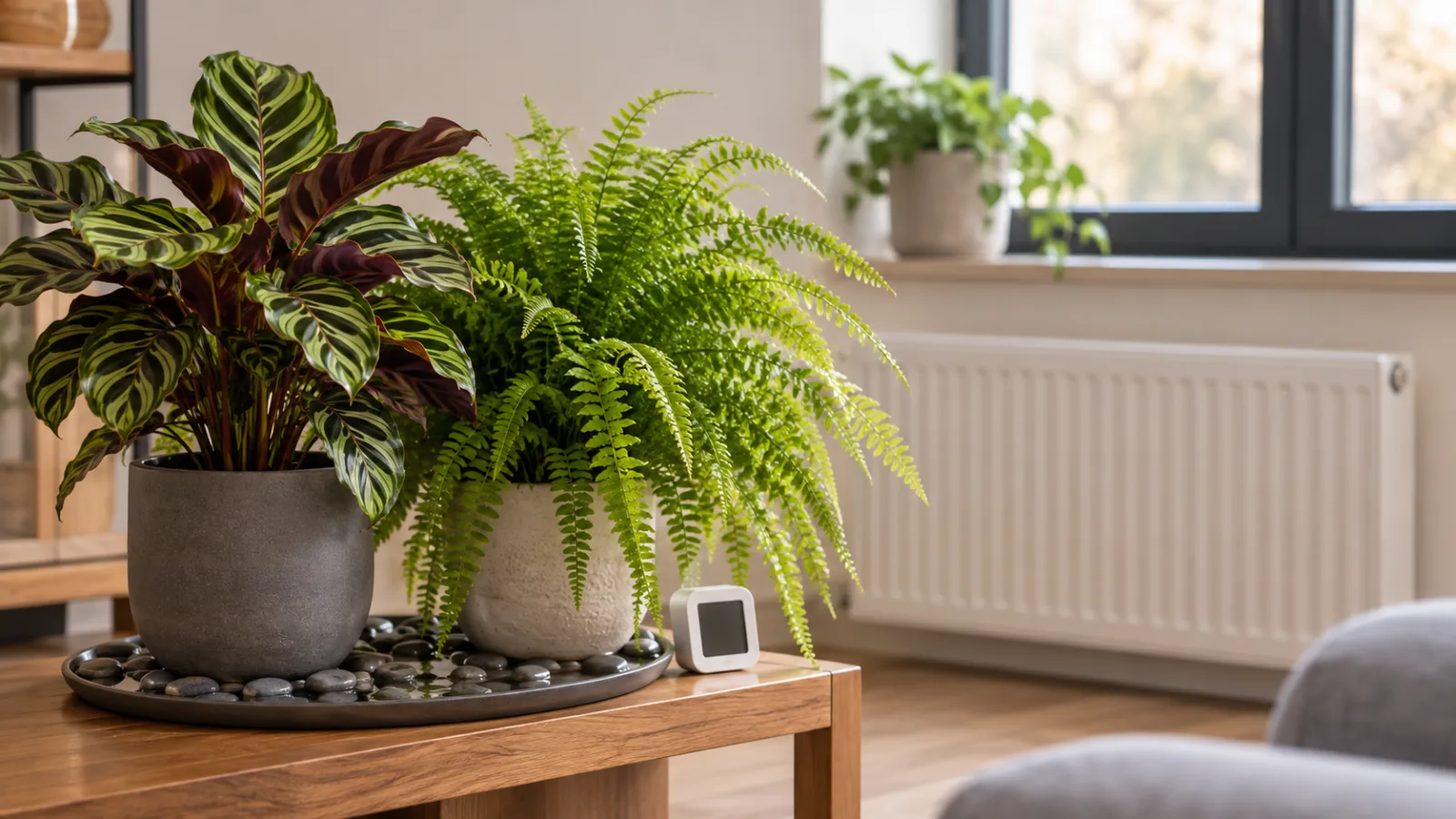
Not every plant minds. Penn State and Maryland both make an exception for cacti and succulents, which tolerate dry air. The plants that suffer in a heated house are the thin-leaved tropicals: the RHS names ferns, calatheas, marantas and orchids as the ones that appreciate extra humidity in winter.
What to do
Move the plant away from the heat source first. Nothing else on this list outweighs distance. The RHS warns that being too near radiators or fires can crisp delicate leaves, and Maryland Extension's advice is not to place indoor plants near heat or air-conditioning sources. A shelf directly above a radiator is the driest, hottest spot in the room. If you have forced-air heating, University of Illinois Extension suggests turning off or redirecting the hot, dry air from vents near plants.
Measure before you change anything. A cheap digital hygrometer tells you what the room is doing, which a leaf can only tell you weeks later. Penn State suggests checking a bathroom with one before relying on it for humidity, and the same goes for any room. Read it at the plant, not across the room by the door.
Group the humidity-lovers together. As plants transpire, they release water vapour, and a cluster of them shares a small pocket of slightly more humid air. Nebraska Extension, Maryland Extension and the RHS all recommend it. Penn State adds the honest caveat: how much it helps depends on the number of plants and the size of the room. Five ferns in a corner do more than one in a large open room.
Use a humidifier for a real change. It is the only fix on this list that raises the humidity of a whole room. Penn State, Nebraska and Maryland all recommend one, either fitted to the heating system or a portable unit for the room the plants live in. Penn State notes that even a whole-house humidifier won't bring the air up to ideal levels for houseplants, but it will help, and it helps the people in the house as well.
Treat pebble trays as a small, local help. A tray of gravel kept topped up with water, the pot sitting on the stones and above the water line, is advice the RHS, Nebraska and Maryland all give. Nebraska is specific that the pot must never sit in the water, or the compost stays wet and the roots rot. Penn State is more sceptical: the evaporating water spreads into the whole room and makes almost no overall difference to its humidity. Both can be true. A tray raises the air right around the leaves a little, and does nothing for the room.
If you do mist, mist early and skip the fuzzy leaves. Nebraska Extension warns that leaves kept wet are more prone to leaf spot diseases, and advises misting early in the day so leaves are dry by night. Maryland Extension adds tepid water, and no misting at all for plants with fuzzy leaves such as African violets.
Mind the windowsill at night. The RHS warns against leaving plants behind drawn curtains in winter, because the space between curtain and glass gets very cold, and against cold draughts, which can shock a plant. A sill above a radiator can swing between the two in a single day: hot, dry air all evening, then a cold pocket behind the curtain overnight.
Keep watering by the compost, not by the season alone. The RHS advises that with lower light and lower temperatures in winter, plants grow less and need less water, and Illinois Extension says most houseplants will be watered less often. Dry, heated air works the other way, because a plant losing water fast through its leaves draws on the compost faster too. A fern near a warm radiator can dry out sooner than the calendar suggests, so check the compost with a finger before watering, whatever the date.
Three ways this plays out
The calathea above the radiator
A calathea has spent its first winter on a shelf directly over a radiator, because that is where the light is. By December every new leaf comes in with brown, papery edges. A hygrometer on the shelf reads 28% in the evening with the heating on. The fix is not a spray bottle. It moves a metre and a half along the wall, out of the rising warm air, onto a pebble tray beside two other plants, with a small humidifier set to run in the evenings. The leaves already damaged stay brown, but the next new leaf opens clean. The lesson: distance from the heat does more than any amount of water sprayed on the leaves.
The Boston fern misted twice a day
A Boston fern in a heated living room is misted every morning and every evening, and it still sheds crisp, brown fronds onto the floor. Each misting lifts the humidity around it for a few minutes, then the room is back to dry for the other twenty-three hours. Its owner moves it into the bathroom, which gets a shower every morning and has a frosted window with fair light, and the shedding slows. A hygrometer confirms the bathroom runs noticeably more humid than the living room. The lesson: misting treats a few minutes of the day. A room that stays more humid treats all of it, provided it also has the light.
The jade plant that didn't need anything
A jade plant and a prayer plant share a sunny windowsill in a centrally heated flat. The prayer plant's leaf tips go brown in November, so its owner puts both plants on a pebble tray and starts misting both. The jade plant was never struggling: it is a succulent, and dry air is what it is built for. It needed none of this treatment. The prayer plant moves to a grouped corner with the other tropicals, and the jade plant stays alone on the sill. The lesson: humidity is a need of some plants, not all of them. Sort the collection before you treat it.
What Botanical Legacy does about it
Humidity is one of the inputs that change how fast a pot dries, and a heated room in winter sets it very differently from the same room in June. The aim is for each Specimen's forecast to run on the air in its own room rather than on a fixed guess.
A humidity sensor belongs to a room. Sensors connect through Home Assistant, on the paid plan and during the trial. A temperature-and-humidity sensor binds to a room in your Sanctuary, not to a single plant, because air is shared, so one sensor covers every Specimen in that room. How to connect a plant sensor to Home Assistant walks through the setup, and where to place a plant sensor covers where it should sit.
The room's reading feeds the watering forecast. Each time a Specimen's Digital Shadow is recalculated (every night, and after you log care), it takes the room's latest temperature and humidity, as long as the reading is under four hours old. The two together give the air's drying power, and at the same temperature, drier air raises the modelled drying rate of the compost. That rate is kept within limits tied to the Specimen's usual watering interval, so a sudden swing in one reading can't throw the forecast out of all proportion. A soil-moisture sensor's measured dry-down replaces the model on a Specimen that has one.
Without a sensor, it says what it is guessing. On the paid plan with local weather on, a Specimen indoors with no room sensor gets an indoor estimate made from your local weather: the outdoor temperature raised a few degrees and kept within a habitable band, and the outdoor humidity used as a ceiling, never above 60%, because heating and air-conditioning both dry a room. With no weather either, it assumes 21°C and 50%. A room sensor reading under four hours old replaces both.
The plant page shows the reading against the plant's preference. A Specimen's page shows the humidity the forecast is using, labelled with where it came from (Room sensor, Weather estimate or Assumed), and beside it the humidity its kind prefers, as a target. A reading of 28% labelled Room sensor, next to a high-humidity target, is the calathea above the radiator in two numbers. Readings are stored once an hour for 30 days and charted, so you can see the evening dip when the heating comes on.
What the model can't see
A room sensor measures the air where it is mounted. It cannot tell that one plant sits over the radiator and another across the room, and it treats every Specimen in that room as breathing the same air. If one shelf runs hotter and drier than the rest, put the sensor near the plants that care most, or treat that spot as a different room.
It also doesn't raise an alert when the air gets dry. Humidity moves the watering forecast and shows on the plant page, but there is no notification for a low reading, so the evening dip on the chart is yours to notice and act on. And a sensor can't see a leaf. Brown tips have other causes too, under-watering and salt build-up from feed among them, so a low humidity reading is a good suspect, not a diagnosis. How to read plant health signs covers telling them apart.
Finally, it only knows what is bound. Without a room sensor and without local weather, the forecast runs on an assumed 50%, which in a heated flat in January is very likely higher than the truth. The label on the plant page says so, so you are never shown a guess dressed as a measurement.
Frequently asked questions
Does central heating affect houseplants?
Yes. Heating warms the air without adding moisture, so its relative humidity falls. Penn State Extension notes that indoor humidity can easily fall below 30% in the heating season, and the RHS warns that being too close to radiators can dehydrate leaves and brown their edges. Thin-leaved tropical plants such as ferns, calatheas and marantas are the most affected. Cacti and succulents tolerate dry air.
What humidity do houseplants need in winter?
It depends on the plant, and Penn State Extension is clear that there is no single best level for all of them. Most indoor plants do better with more humidity than a heated home usually has in winter. Tropical foliage plants, ferns and orchids want the most, while cacti and succulents are content with dry air. A hygrometer at the plant is the only way to know what your room is giving it.
Does misting houseplants increase humidity?
Not for long. Penn State Extension notes that the rise in humidity after misting lasts only until the water evaporates, which takes minutes, so even daily misting doesn't raise the humidity around a plant. Nebraska Extension calls it not an effective solution and warns that leaves kept wet are more prone to leaf spot. Grouping plants, moving them away from heat and running a humidifier all do more.
Do pebble trays work for humidity?
A little, and only right around the plant. The RHS and Nebraska Extension recommend a tray of gravel kept topped up with water, with the pot above the water line so the roots don't sit wet. Penn State Extension notes that the evaporating water spreads into the whole room, so it makes almost no difference to the room's humidity. Treat a tray as a small local help, not a fix for a dry room.
Why are my plant's leaf tips going brown in winter?
Dry air is one common cause: Nebraska Extension lists browning at leaf edges or tips as a typical sign of low humidity, and the RHS links it to plants placed close to radiators. It is not the only cause. Under-watering, and salts left in the compost by feed, can produce the same brown tips. Check the humidity at the plant and the moisture in the compost before deciding which it is.
Is it bad to put plants on a windowsill above a radiator?
For humidity-loving plants, usually yes. Rising hot air dries the leaves, and the RHS warns that being too near radiators can crisp delicate leaves. At night, if curtains are drawn in front of the sill, the plant is left in a cold pocket against the glass, which the RHS also warns against. A sunny sill above a radiator suits a succulent far better than a fern.
Can Botanical Legacy track humidity for my plants?
Yes, on the paid plan and during the trial, through a temperature-and-humidity sensor connected via Home Assistant. The sensor binds to a room, and every Specimen in that room uses its latest reading, if it is under four hours old, in its watering forecast. The plant page shows the reading, labelled with its source, beside the humidity that kind of plant prefers. There is no alert for low humidity.
Start your sanctuary
Botanical Legacy's free plan covers up to five Specimens, indoors or out, with continuous Digital Shadow modelling and a watering forecast for every Specimen. Every new account also gets a 14-day trial of the paid plan, which adds local weather and sensor support via Home Assistant, including room temperature-and-humidity sensors that feed each Specimen's forecast.
Start your sanctuary - five free specimens, no payment required →
The radiator heats the room. Your hygrometer tells you what that heat costs the fern.
Sources
11 references
The plant-care facts on this page were checked against these references.
- US National Weather Service: weather.gov/lmk/humidity
- Penn State Extension: extension.psu.edu/humidity-and-houseplants
- NC State Extension Gardener Handbook: content.ces.ncsu.edu/extension-gardener-handbook/18-plants-grow…
- RHS: rhs.org.uk/plants/types/houseplants/growing-guide
- RHS winter houseplant care: rhs.org.uk/garden-inspiration/houseplants/winter-interest-house…
- Nebraska Extension: lancaster.unl.edu/success-houseplants-humidity
- Clemson HGIC: hgic.clemson.edu/factsheet/houseplant-diseases-disorders
- UMD Extension: extension.umd.edu/resource/temperature-and-humidity-indoor-plan…
- University of Illinois Extension: extension.illinois.edu/blogs/over-garden-fence/2022-02-07-house…
- University of Illinois Extension: extension.illinois.edu/houseplants/watering
- UMD Extension: extension.umd.edu/resource/fertilizer-toxicity-or-high-soluble-…