Plant care · 13 min read
What a plant disease identifier should tell you, and what a photo can't
Most houseplant problems come from care and conditions, not disease, and many causes leave the same marks on a leaf. What a plant disease identifier app can read from a photo, what it can't, and how to give it a photo worth reading.
Botanical Legacy · Field notes ·
A photo shows what the leaf is doing. It cannot show what happened to the pot last week.
Most sick houseplants are not diseased
Point a plant disease identifier at a yellowing leaf and it will usually name something. The extension services that diagnose plants for a living start from a different place. UC IPM, the University of California's pest management programme, says most houseplant problems are due to improper care, such as not enough light or too much water. Clemson's Home and Garden Information Center says the same: houseplants can develop many problems, but most have environmental or cultural causes. Iowa State adds that houseplant diseases are often secondary, the result of poor conditions or care, and Penn State notes that diseases are generally rarer and harder to treat than insect infestations.
That changes what a photo can do. A leaf shows symptoms, and symptoms are shared between causes. Clemson lists too little light, too little fertiliser, insect pests and mites as causes of yellow foliage, then adds that most often, yellowing comes from overwatering. UC IPM puts brown leaf tips down to overfeeding, salt build-up, or soil kept too dry or too wet, and the RHS calls brown tips a classic sign of low humidity. The RHS also warns that overwatering can make a plant wilt, which is easy to mistake for thirst. Penn State's overview of plant diagnostics sums it up: injury from insects, disease and growing conditions can look very similar and be hard to tell apart.
Diagnosticians separate two kinds of evidence. Penn State defines a symptom as the plant's response to the damage, and a sign as the physical presence of the organism causing it. Signs are the stronger evidence: Iowa State lists fungal growth and bacterial ooze among them, and notes that problems caused by conditions show no signs at all. Mites, mealybugs, webbing and the white coating of powdery mildew are signs. A yellow leaf is a symptom.
They also read patterns over time. Colorado State's guide to diagnosing plant disorders notes that problems caused by living organisms tend to develop progressively and spread unevenly across the plant, while symptoms that appear suddenly and do not progress, or that show on several kinds of plant at once, are typical of problems with conditions. Iowa State puts it simply: damage from conditions does not spread from plant to plant over time. Colorado State also asks the question no photo answers: did the damage appear suddenly or over a period of time?
So the limit is not only how good the software is. The University of Wisconsin's plant disease clinic says very few diseases can be accurately diagnosed by eye, and Colorado State says some problems can only be confirmed in a diagnostic laboratory. NC State's plant clinic, which accepts photos, still cannot guarantee a diagnosis from photos alone. Research on image-based diagnosis points the same way. A widely cited 2016 study in Frontiers in Plant Science trained a model that scored over 99% on its own test images, taken in controlled conditions, and just above 31% on images from other sources. A 2020 field study of a smartphone app for cassava disease, in the same journal, found single-leaf diagnoses unreliable, at 49% accuracy in the field, rising to between 74 and 88% when six leaves per plant were checked.
The popular idea is that a disease identifier is a doctor in your pocket. A better comparison is a well-read friend looking at a photo you sent: useful, quick, and only as good as the photo and the story you tell with it.
What to do
Photograph the whole plant, then the damage. Missouri's integrated pest management programme asks for three to six photos of a sample, taken from different distances, including the transition where healthy tissue meets damaged tissue. Illinois' plant clinic asks for samples that show both healthy and affected parts. One close-up of one spotted leaf is the photo most likely to mislead any identifier, human or software.
Note where it started. The RHS points out that a dry plant yellows and drops its older leaves at the base first, while an overwatered one yellows and drops old and new leaves at the same time. Which leaves, which side and how fast is information a single photo rarely carries, so write it down before you ask anyone.
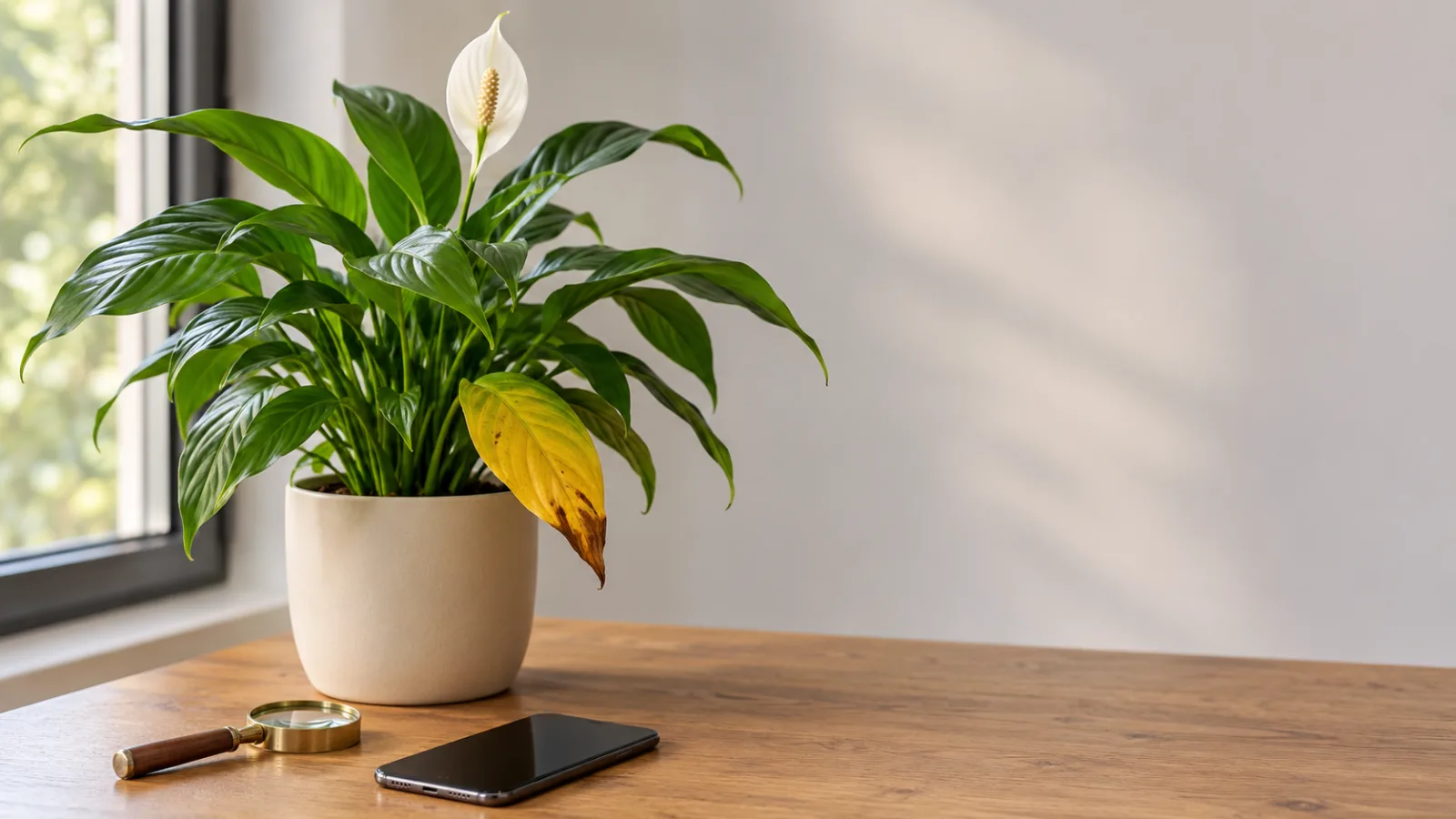
Look for signs with a lens. UC IPM recommends a 10x hand lens for finding mites, which leave light specks called stippling on the leaves; thrips leave similar stippling. Penn State adds fine webbing and grey or bronze discolouration for spider mites, and white, cottony clusters for mealybugs. A pest you can see beats a disease you suspect.
Check the roots when it wilts in wet compost. UC IPM advises inspecting the roots whenever a plant wilts, and says healthy roots are white. The University of Wisconsin notes that root rot is often noticed when a plant is wilted even though the soil is wet, with roots that are soft and brown and may smell bad. Slide the plant out of its pot before you believe any diagnosis of a wilting plant.
Ask what changed. Penn State's first step after looking at the plant is to get its history: how it has been watered, fed and moved. A new spot, a repot, a cold night against the glass or a week of heavy watering explains more problems than a pathogen does.
Isolate it first. UC IPM advises isolating a plant with a problem immediately, so it cannot spread to the others, and Penn State and the RHS say the same. Penn State also suggests keeping new plants apart for about three weeks.
Treat the cause, not the photo. A fungicide does nothing for a problem with the growing conditions, as University of Georgia Extension points out, and Iowa State notes that fungicides do not control diseases caused by bacteria or viruses. The University of Wisconsin does not recommend chemical fungicides for root rot in houseplants at all. Clemson and the RHS both advise removing badly damaged leaves.
Keep the leaves dry. Iowa State links leaf spots to wet leaves from misting or watering, poor air circulation and overcrowding, and UC IPM notes that many leaf-spot fungi need hours of continuous leaf wetness to infect. Water the compost, not the foliage, and give the plant room.
Three ways this plays out
The peace lily that looked thirsty
A peace lily droops one afternoon, leaves hanging over the rim. It looks exactly like a thirsty plant, and its owner waters it. The next day it droops further. The compost is wet a finger deep, and when the plant comes out of its decorative pot, the inner pot is standing in water, and the roots are brown and soft. The fix is a fresh pot with drainage, damaged roots trimmed away, and watering only when the top of the compost has dried. The lesson: a wilting plant in wet compost is a root question, and only the roots can answer it.
The calathea with "leaf spot"
A calathea develops a fine pale speckling across several leaves, and from arm's length it looks like the start of a leaf-spot disease. Under a hand lens, the speckles are stippling, and on the undersides there are tiny moving dots and a few strands of webbing. Spider mites. The plant goes into isolation, and the neighbours are checked with the same lens before anything is sprayed. The lesson: look for the organism before you name the disease. A sign settles what a symptom only suggests.
Three plants, one cold night
A jade plant, a pothos and a spider plant share a windowsill. One morning in December all three show damaged, darkened patches on the leaves nearest the glass, and nowhere else. Three different plants, the same damage, all at once, on the side facing the window: that is the pattern Colorado State describes for problems with conditions, not disease. The curtain had been drawn in front of the sill the night before, leaving the plants in the cold pocket against the glass. They move back from the window at night, and no new damage appears. The lesson: when unrelated plants show the same damage at the same moment, look at the place before the plant.
What Botanical Legacy does about it
Botanical Legacy's photo diagnosis is the Doctor, powered by Botanical Vision v5. It is built to read a photo with the plant's record beside it, rather than a photo on its own.
One photo read per diagnosis. A diagnosis uses one photo read from the same monthly allowance as identifying a plant: three on the free plan, 120 on Cultivator and 360 on Conservancy. If the run fails, the photo read is given back. A photo that turns out not to be a plant, or to be a different plant from the Specimen on file, still uses it.
It reads the photo with the record. Along with the photo, the Doctor is given what the Specimen's record holds: its species, whether it lives indoors or out and where, its current watering and feeding intervals, and, when there are any, a summary of the last seven days of readings from its own sensors and its room's sensor, or local weather for an outdoor plant. A drooping plant whose soil sensor read wet all week is a different case from one that read dry.
Whole plant or close-up, and you say which. On the plant page, on the iOS and Android apps and on the web, you choose whether the photo shows the whole plant or a close-up. A close-up is read as part of the plant, so one bad leaf cannot mark the whole Specimen as more than mildly stressed.
What comes back. A health verdict with a confidence percentage; the findings, including any likely disease or pest, flagged when a pest is contagious; the care steps; a verdict on whether the light is adequate; feeding advice; and the areas it found marked on the photo. The Doctor is told to prefer uncertainty to a guess, and to give a status of Observe rather than a disease name for symptoms it cannot pin on one. On a later photo, the plant's page compares it with the previous one and says whether the plant looks to be improving, worsening or stable.
It notices when the photo is of another plant. If the photo shows a different plant from the Specimen on file, the Doctor says so and does not apply the reading to that Specimen.
It keeps the history. Every diagnosis is saved to the Specimen's journal, so the next one, and you, can see what was found and when. A diagnosis changes how the plant's health reads in the app. It does not rewrite the watering forecast, which keeps running on the compost: your plant's Digital Shadow explains how.
What the model can't see
The Doctor sees the frame you send, and only that frame. It cannot turn the plant over to check the undersides for mites, slide it out of the pot to look at the roots, or check the six leaves the cassava study needed. If the evidence is not in the photo, it is not in the diagnosis, so photograph the underside, the base of the stems, and the roots too when the plant is wilting in wet compost.
It does not read your care log. The watering and feeding you have logged are not part of what it is given, so a week of heavy watering reaches it only through a soil sensor's readings, if the Specimen has one. Tell yourself the story the photo can't: what changed, and when.
It cannot culture a sample. A confidence percentage is the model's own estimate, not a laboratory result, and some problems, as Colorado State and the University of Wisconsin both say, can only be confirmed in a lab. For a valuable plant, a spreading problem in a collection, or anything that does not improve after the cause has been treated, a local extension plant clinic is the next step. How to read plant health signs and why plant leaves turn yellow cover the checks to run first.
Frequently asked questions
How accurate are plant disease identifier apps?
It depends on the photo and the problem, and most apps do not publish field accuracy. Research gives a sense of the range: a 2016 model scored over 99% on images like its training set and just above 31% on images from other sources, and a 2020 field study of a cassava disease app found 49% accuracy from single leaves, rising to 74 to 88% when six leaves per plant were checked. More photos of more of the plant help.
Can you diagnose a plant disease from a photo?
Sometimes, and rarely with certainty. The University of Wisconsin's plant disease clinic says very few diseases can be accurately diagnosed by eye, and NC State's plant clinic cannot guarantee a diagnosis from photos alone. A photo is strongest when it shows a sign, such as mites, webbing or a powdery coating, and weakest when it shows only a symptom, such as yellowing, that many causes share.
What is the most common cause of houseplant problems?
Care and growing conditions. UC IPM says most houseplant problems come from improper care such as too little light or too much water, and Clemson's Home and Garden Information Center says most have environmental or cultural causes. Clemson names overwatering as the most common cause of yellowing leaves. Check the compost, the light and any recent change before suspecting a disease.
How do I take a good photo of a sick plant?
Take several, from different distances. Missouri's integrated pest management programme suggests three to six photos per sample, including where healthy tissue meets damaged tissue, and Illinois' plant clinic asks for both healthy and affected parts. Add the undersides of affected leaves, the base of the stems, and the roots if the plant is wilting. Use daylight and keep the plant in focus.
What is the difference between a sign and a symptom?
Penn State Extension defines a symptom as the plant's response to damage, such as yellowing, wilting or spots, and a sign as the physical presence of the organism causing it, such as fungal growth, insects or webbing. Signs are the stronger evidence. Iowa State notes that problems caused by growing conditions show no signs at all.
Should I use a fungicide on my houseplant?
Only once a fungal disease has been identified, and often not even then. University of Georgia Extension points out that fungicides do nothing for problems caused by conditions, Iowa State notes that they do not control bacterial or viral diseases, and the University of Wisconsin does not recommend them for root rot in houseplants. Isolating the plant, removing badly affected leaves, fixing the watering and keeping leaves dry come first.
How does the Doctor in Botanical Legacy work?
You photograph a Specimen, as the whole plant or a close-up, and the Doctor, powered by Botanical Vision v5, reads it alongside the plant's record: its species, where it lives, its watering and feeding intervals, and a week of its sensor or weather readings when there are any. It returns a health verdict with a confidence percentage, findings, care steps, a light verdict and marked areas on the photo. Each diagnosis uses one photo read, and the free plan includes three a month.
Start your sanctuary
Botanical Legacy's free plan covers up to five Specimens, indoors or out, with continuous Digital Shadow modelling and three photo reads a month for the Doctor or identification. Every new account also gets a 14-day trial of the paid plan, which adds local weather and sensor support via Home Assistant, so a diagnosis can be read against what the plant's soil and room have been doing all week.
Start your sanctuary - five free specimens, no payment required →
The leaf shows the damage. The roots, the lens and last week's watering show the cause.
Sources
17 references
The plant-care facts on this page were checked against these references.
- UC IPM Pest Notes: Houseplant problems: ipm.ucanr.edu/PMG/PESTNOTES/pn74172.html
- Clemson HGIC: hgic.clemson.edu/factsheet/houseplant-diseases-disorders
- Iowa State Extension: yardandgarden.extension.iastate.edu/how-to/diagnosing-houseplan…
- Penn State Extension: extension.psu.edu/pest-and-disease-problems-of-indoor-plants
- RHS: how to help a poorly houseplant: rhs.org.uk/plants/types/houseplants/how-to-help-a-poorly-housep…
- Penn State Extension: overview of plant diagnostics: extension.psu.edu/overview-of-plant-diagnostics
- Iowa State Extension: biotic vs abiotic: yardandgarden.extension.iastate.edu/how-to/biotic-vs-abiotic-di…
- NC State Extension Gardener Handbook ch. 5: content.ces.ncsu.edu/extension-gardener-handbook/5-diseases-and…
- Colorado State Extension: diagnosing plant disorders: extension.colostate.edu/resource/diagnosing-plant-disorders
- University of Wisconsin Extension: root rots of houseplants: hort.extension.wisc.edu/articles/root-rots-houseplants
- NC State Plant Disease and Insect Clinic: plantpathology.ces.ncsu.edu/modified-plant-disease-and-insect-c…
- Mohanty et al. 2016, Frontiers in Plant Science: frontiersin.org/articles/10.3389/fpls.2016.01419/full
- Mrisho et al. 2020, Frontiers in Plant Science: pmc.ncbi.nlm.nih.gov/articles/PMC7775399
- University of Missouri IPM: ipm.missouri.edu/MEG/2025/3/digital_submission-pt
- Illinois Extension Plant Clinic: extension.illinois.edu/plant-clinic/how-prepare-your-sample
- University of Georgia Extension: site.extension.uga.edu/fultonag
- RHS winter houseplant care: rhs.org.uk/garden-inspiration/houseplants/winter-interest-house…