Species care guide
Chilli pepper
Capsicum annuum
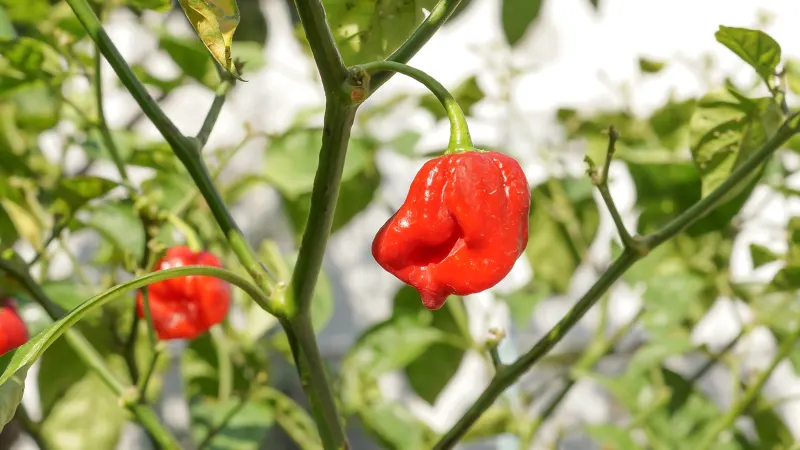
How to grow chilli peppers (Capsicum annuum) in a pot on a sunny windowsill or balcony: when to sow and how warm the seed needs to be, the light and water that keep flowers from dropping, how to pollinate them indoors, when to pick, and how to keep a plant over winter.

- Light
- Full sun, at least six hours of direct sun a day: the warmest, sunniest window you have, or a sheltered, sunny balcony in summer
- Water
- Keep the compost steadily moist; a plant that dries out drops its flower buds, and in hot weather a pot may need water every day
- Humidity
- Likes some humidity; hot, dry air and dry compost can stop the fruit from setting
- Temperature
- Grows best above 15°C, with nights no colder than about 12°C; above 30°C fruiting falls, and frost kills it
- Pets & toxicity
- Not on the ASPCA list; the RHS marks its chilli entries as an irritant to people and pets if eaten, and to skin and eyes, so wear gloves to handle them
- Difficulty
- Easy in a sunny spot with an early start; the skills are steady watering and helping the flowers pollinate indoors
A chilli is grown as an annual, but the plant is a frost-tender perennial. The first frost ends its season only if you leave it outside.
What a chilli pepper is
The chillies in this guide are Capsicum annuum, the species that NC State Extension also lists under the names sweet pepper, cayenne and ornamental pepper. It belongs to the nightshade family, Solanaceae. NC State places its native range in northern South America and southwestern North America, and describes it as a frost-tender perennial. NC State's own attribute list gives its life cycle as annual, which is how most gardeners treat it: sown in late winter and cleared after the autumn. The plant itself can go on.
The RHS describes chillies as tender plants that need heat, humidity and plenty of sun. Their size depends on the variety: compact types stay around 20–30 cm tall, which is what makes them good windowsill plants. The flowers are small, white to purple and not showy, according to NC State, and the fruit comes in red, orange, yellow, green and black, in a wide range of shapes and strengths.
That strength is capsaicin. Clemson HGIC explains that heat is measured on the Scoville scale in Scoville Heat Units, which reflect capsaicin content; a jalapeño measures 2,500–8,000. The RHS gives a range from about 500 for 'Anaheim' to 2.2 million for 'Carolina Reaper'. Heat varies with the variety, the growing conditions and how ripe the fruit is, the RHS notes. Iowa State Extension adds a detail that surprises most people: capsaicin is made in glands on the placenta, the membrane that joins the seeds to the fruit, and the seeds pick it up only by touching it. NC State notes that birds are not affected by capsaicin and eat the fruit safely.
Why chillies need a long, warm start
A chilli takes a long time to go from seed to fruit. Clemson HGIC gives 100–120 days from seed to harvest for peppers, or 70–85 days from transplanting. That is why the RHS advises sowing indoors from late winter to mid-spring: chillies need a long season, and an early start gives an earlier and longer harvest.
Warmth matters at every stage. The RHS says chilli seed germinates best at about 21°C, in a heated propagator or on a warm windowsill. Once the seedlings are up, take them out of the propagator and grow them on at 16–18°C, in bright light, with the compost evenly moist. When they are 2–3 cm tall, move each one into its own module or small pot of peat-free compost, and once roots show through the drainage holes, into a 13 cm pot.
Then the plant needs heat to grow and flower. The RHS says chillies tolerate a night minimum of about 12°C but grow better above 15°C, and that young plants must stay indoors in the warmth until at least late May. Clemson HGIC gives the ideal as 21–29°C by day and 16–21°C at night, and notes that peppers grow very slowly in cool weather. University of Illinois Extension warns that when nights fall below about 10–13°C, plants grow slowly, leaves may yellow and flowers may drop.
Heat has a ceiling too. The RHS says temperatures above 30°C can reduce fruiting. Iowa State Extension notes that bell pepper flowers may drop when nights fall below about 16°C or days rise above about 29°C, and that hot peppers generally set fruit better in warm weather than bell peppers do. If yours grows under glass in summer, the guide to greenhouse care in a heat wave covers keeping it below that ceiling.
Light: the sunniest spot you have
Chillies are sun plants. NC State Extension and Iowa State Extension both call for full sun, at least six hours of direct sun a day, and the RHS says to give them your warmest, sunniest spot. A greenhouse, polytunnel or sunny conservatory gives the best crops, according to the RHS, but compact varieties can be grown on a sunny windowsill indoors, and the RHS entries for several chilli varieties describe them as suited to a glasshouse or a sunny windowsill.
For a balcony, the RHS advice for outdoor chillies applies: a sheltered, sunny site, such as against a south-facing wall. Wait until nights stay above about 12°C, the threshold the RHS gives for planting peppers out, and harden the plants off for a couple of weeks first. The sunlight and timing rules for fruiting crops are set out in more detail in how to grow vegetables indoors and how to start a vegetable garden.
If you use Botanical Legacy, the place you put a Specimen in carries the light you described for it, as a level or as the window's direction. When a plant's light needs and its place don't match, the app flags it and names a better place you already have. It cannot measure the light or the temperature of the room, so finding the sunniest, warmest spot is still your job.
How to water a chilli
Steady moisture is the rule, and dry compost shows first in the flowers. The RHS says to keep the compost steadily moist, because dry conditions can make the flower buds drop, and warns that plants in containers may need watering every day in hot, dry weather. NC State Extension says to keep the soil consistently and evenly moist. Clemson HGIC calls moisture most critical during fruit set and fruit development, and says not to let the soil dry out between waterings.
Uneven watering also causes the most common fruit problem. Iowa State Extension explains that blossom end rot, water-soaked spots at the tip of the fruit that turn brown and leathery, comes from a shortage of calcium in the developing fruit, and that fluctuating soil moisture is one of the causes. Clemson HGIC links it to interrupted watering, and recommends compost kept uniformly moist but not saturated. Use a pot with a drainage hole, so steady does not become waterlogged.
The longer method of reading a pot, rather than a calendar, is in when to water your houseplants. A model of the individual plant helps with a pot that may need water daily in hot weather. Botanical Legacy keeps a Digital Shadow of each Specimen in your Sanctuary, a running estimate of when that particular pot will be dry. On every plan, including the free one, you can log a quick soil check from the Specimen's page, from bone dry to wet. After three checks between waterings, the model starts correcting its drying rate for that plant from what you found.
Feeding, pinching and support
Feed once the plant starts to flower. The RHS recommends a weekly high-potassium liquid feed for plants in containers from the start of flowering. Go easy on nitrogen: Clemson HGIC notes that lots of foliage with few flowers and fruit points to too much of it, and Iowa State lists high nitrogen among the factors behind blossom end rot.
Pinching is optional. The RHS says it is not usually needed, but pinching out the growing tip when a plant reaches about 30 cm gives more, smaller fruits, at the cost of delaying fruiting. NC State Extension notes that pinching young plants makes them bushier.
Taller varieties need a cane. The RHS warns that the stems are brittle, so tie them in carefully, and Clemson HGIC advises cutting fruit off rather than pulling it, for the same reason.
Pollination indoors
Outdoors, pollination looks after itself. Indoors, it is the step most windowsill growers miss. Iowa State Extension lists peppers as self-pollinated, and Colorado State University Extension explains why: each pepper flower is "perfect", carrying both male and female parts, and can pollinate itself with only a little air movement. Wind and bees are not required, but they help, by knocking the pollen off the stamens. A bee does it by vibrating its wings.
A windowsill has neither wind nor bees, so do their job. Colorado State suggests lightly tapping the flowers, using a small brush or a cotton swab, or holding an electric toothbrush against the plant to copy a bee's vibration. It gives noon to 3 pm as the best time of day for peppers. If you grow several varieties, use a clean brush or a fresh swab for each, to avoid crossing them.
Even well-pollinated flowers drop when conditions are wrong. Hot, dry winds and dry soil can stop fruit set or make small fruit fall, according to Illinois Extension, and University of Maryland Extension lists peppers among the crops whose flowers do not pollinate properly in a heat wave. Flowers falling off is a sign to check the temperature and the compost before blaming the brush.
Harvesting
You can pick chillies green or ripe, and the choice is a trade-off. The RHS says picking green fruit gives the biggest crop, and that green fruit can ripen indoors. Letting early fruit ripen on the plant gives a richer, hotter flavour but a smaller yield. Iowa State Extension agrees that peppers can be picked green or fully ripe. In a greenhouse, the RHS expects picking from mid-summer into autumn; outdoors, from about August. Cut the fruit off with scissors, since pulling can break the brittle stems.
Hot chillies need some care in the kitchen. Iowa State Extension advises rubber gloves if you are sensitive, and keeping your hands away from your face, eyes and mouth, because capsaicin spreads easily and burns. When processing a quantity of hot peppers, it recommends gloves and a well-ventilated room, because the oils can burn or irritate skin. To dry chillies, Iowa State suggests stringing them on thread and hanging them in a warm, dry, well-ventilated place.
Overwintering a chilli
Because a chilli is a perennial, a plant does not have to end with the season. The RHS says chilli plants can be kept over winter in a heated, bright place, such as an indoor windowsill or conservatory: prune them back to a manageable size and water sparingly. Late in the season it suggests bringing outdoor plants indoors if you can, so the last fruit can keep developing.
Frost is the deadline. Illinois Extension notes that peppers cannot tolerate frost, so bring a balcony plant in before the first one. For tender plants in pots generally, University of Maryland Extension suggests checking for pests and treating them before the plants come in, giving them the brightest window you have, watering less while they adjust and not feeding until new growth starts in late winter or spring. It also warns that some leaf drop is normal after the move. The guide to when to bring plants inside for fall covers the timing and the pest check in more detail.
If your chilli spends the summer on a balcony, Botanical Legacy can watch the forecast for it. On the paid plan, with local weather and weather alerts turned on, the forecast low for your home location is compared with the minimum temperature recorded for each Specimen in an outdoor place, such as a balcony. A forecast that drops below that minimum brings a frost alert for that plant by name, ahead of the night. A forecast that only comes within 2°C of it is reported when that cold is unusual for the time of year, or when it is the first such night in a month. A Specimen with no recorded minimum is guarded as a tender plant.
Common problems
Flowers dropping off. The most common complaint, with several causes. Dry compost makes buds drop, the RHS says. Cold nights do it too: Illinois Extension gives nights below about 10–13°C. So does heat: the RHS says fruiting falls above 30°C. Indoors, the flowers may also have gone unpollinated, so tap or brush them. Check the compost first, then the temperature.
Brown, leathery patches at the tip of the fruit. Blossom end rot, from a shortage of calcium in the fruit, which Iowa State Extension and Clemson HGIC tie to uneven watering. Water steadily. The RHS notes that it does not mean the crop is lost.
Pale, papery patches on the side of the fruit. Sunscald. Iowa State Extension describes a soft, light-coloured area on the side of the fruit that faces the sun, which later dries out and turns white and papery.
Lots of leaves, few flowers. Too much nitrogen, according to Clemson HGIC. Switch to the high-potassium feed the RHS recommends once flowering starts.
Slow growth and yellowing leaves in spring or autumn. Cold is one cause: Illinois Extension notes that nights below about 10–13°C slow the plant and can yellow its leaves. Move it somewhere warmer.
Pests. The RHS warns that sap-sucking pests are a particular risk indoors, and lists aphids, glasshouse red spider mite and glasshouse whitefly among the common problems, along with grey mould. NC State Extension adds aphids and whiteflies to its list for the species. A photo to the Doctor, powered by Botanical Vision v5, returns a health verdict, the likely cause of what it sees, and what to do. The guide to common houseplant pests shows how to tell them apart.
Frequently asked questions
When should I sow chilli seeds?
Indoors, from late winter to mid-spring, as the RHS advises. Chillies need a long season, and Clemson HGIC gives 100–120 days from seed to harvest, so an early start gives an earlier and longer crop. The seed germinates best at about 21°C, in a heated propagator or on a warm windowsill.
Can you grow chillies indoors all year?
You can keep one indoors all year, and compact varieties grow well on a sunny windowsill, according to the RHS. It needs full sun, at least six hours of direct sun a day, temperatures above about 15°C for good growth, and help with pollination. Over winter, the RHS suggests a warm, bright windowsill, pruning it back and watering sparingly.
Why are my chilli flowers falling off?
Usually dry compost, the wrong temperature, or no pollination. The RHS says dry conditions make buds drop; Illinois Extension says nights below about 10–13°C do too; and the RHS says fruiting falls above 30°C. Indoors, tap the flowers or brush them gently around the middle of the day, as Colorado State University Extension suggests, so the pollen reaches the stigma.
Do I need to hand-pollinate chillies?
Indoors, it helps. Pepper flowers can pollinate themselves, Colorado State University Extension explains, but they need a little air movement or an insect to shake the pollen loose. On a windowsill there is neither, so tap the open flowers, or use a small brush, a cotton swab or an electric toothbrush held against the plant.
Can I keep my chilli plant over winter?
Yes. NC State Extension describes Capsicum annuum as a frost-tender perennial, and the RHS says chillies can be kept over winter in a heated, bright place such as an indoor windowsill. Prune the plant back to a manageable size and water it sparingly. Bring it in before the first frost, which Illinois Extension notes peppers cannot tolerate.
Are chilli plants toxic to cats and dogs?
The ASPCA does not list Capsicum annuum. The plant it lists as "ornamental pepper" is a different species, Solanum pseudocapsicum (Jerusalem cherry), which it rates as toxic to dogs, cats and horses. For chillies, the RHS entries for several Capsicum annuum varieties mark the plant as an irritant to people and pets if eaten, and as a skin and eye irritant, and advise gloves when handling it. Keep hot chillies out of reach of pets, and call your vet if one is unwell after eating part of the plant.
Can Botanical Legacy help me grow chillies?
It helps with the parts that change through the season. Each Specimen gets its own Digital Shadow, an estimate of when its pot will be dry, and soil checks you log on any plan teach the model that plant's real drying rate, which matters for a plant that drops its flowers when the compost dries. On the paid plan, with local weather and alerts on, a chilli in an outdoor place such as a balcony can get a frost alert by name before a cold night. Progress photos build growth curves of height and leaf count, so a seedling's progress shows up as a trend instead of a guess.
Start your sanctuary
Botanical Legacy's free Observer plan covers up to five Specimens, each with its own continuously running Digital Shadow and soil checks that teach it each pot's drying rate. A chilli, which drops its flowers when its compost dries and can need water daily in summer, is exactly the kind of plant a steady per-pot model is for. Every new account also includes a 14-day trial of Cultivator, the paid plan, which adds the local weather feed and soil sensor support.
START YOUR SANCTUARY - FIVE FREE SPECIMENS, NO PAYMENT REQUIRED →
Treat a chilli as the perennial it is, and the first frost becomes a reason to bring it in, not to start again.
Sources
17 references
The plant-care facts on this page were checked against these references.
- NC State Extension: plants.ces.ncsu.edu/plants/capsicum-annuum
- NC State Extension: ornamental peppers: plants.ces.ncsu.edu/plants/capsicum-annuum/common-name/ornament…
- RHS: rhs.org.uk/vegetables/chilli-pepper/grow-your-own
- Clemson HGIC: hgic.clemson.edu/factsheet/pepper
- Iowa State Extension: yardandgarden.extension.iastate.edu/how-to/growing-peppers-home…
- RHS: 'Krakatoa': rhs.org.uk/plants/287914/capsicum-annuum-krakatoa-chilli-pepper…
- Illinois Extension: web.extension.illinois.edu/hortanswers/plantdetail.cfm
- RHS: 'Razzamatazz': rhs.org.uk/plants/329591/capsicum-annuum-razzamatazz/details
- RHS: 'Medina': rhs.org.uk/plants/302125/capsicum-annuum-medina/details
- RHS: sweet peppers: rhs.org.uk/vegetables/peppers/grow-your-own
- Iowa State Extension: yardandgarden.extension.iastate.edu/how-to/pollination-and-fert…
- Colorado State University Extension: pueblo.extension.colostate.edu/hand-pollination
- University of Maryland Extension: extension.umd.edu/resource/expect-poor-fruit-set-tomatoes-week
- University of Maryland Extension: extension.umd.edu/resource/overwintering-tropical-plants
- ASPCA cats list: aspca.org/pet-care/animal-poison-control/cats-plant-list
- ASPCA dogs list: aspca.org/pet-care/animal-poison-control/dogs-plant-list
- ASPCA: aspca.org/pet-care/aspca-poison-control/toxic-and-non-toxic-pla…