Species care guide
Rosemary
Salvia rosmarinus
How to grow rosemary in a pot, outdoors in summer and indoors over winter: the sun and drainage it needs, why overwatering kills it indoors, how cold it can take, and how to prune it and root cuttings.

- Light
- Full sun: six hours or more of direct sun outdoors; indoors a south-facing window or a grow light, as low winter light makes overwintering difficult
- Water
- Let the compost dry slightly between waterings; check it with a finger and water thoroughly only when it is dry, in a pot with drainage holes, never leaving it standing in water
- Humidity
- Indoor heated air dries it; a tray of damp pebbles helps, with good air movement to keep powdery mildew away
- Temperature
- RHS H4, hardy to about -10 to -5°C in the ground; indoors over winter keep it cool, about 10–16°C, and away from radiators
- Pets & toxicity
- Non-toxic to cats, dogs and horses per the ASPCA; the RHS lists it as a skin allergen, so wear gloves when handling
- Difficulty
- Easy outdoors in sun and sharp drainage; hard to keep indoors over winter, where low light and overwatering are what kill it
A potted rosemary rarely dies of the winter it is brought in to escape. It dies of the watering can that meets it indoors.
What rosemary is, and why the name changed
Rosemary is an aromatic evergreen shrub in the mint family, Lamiaceae. For most of its history in gardens it was Rosmarinus officinalis. It is now Salvia rosmarinus: the RHS notes that the genus has changed from Rosmarinus to Salvia, NC State Extension lists Rosmarinus officinalis as the name it was previously known by, and University of Wisconsin Extension describes it as recently reclassified. The plant has not changed, only its place in the family tree, and you will still see the older name on labels.
It is a Mediterranean plant. The RHS gives its range as the Mediterranean, and Wisconsin Extension narrows it to the hills along the Mediterranean, Portugal and northwestern Spain. NC State Extension notes that it grows in dry, rocky areas. That is the key to everything below: sun, fast drainage and dry roots.
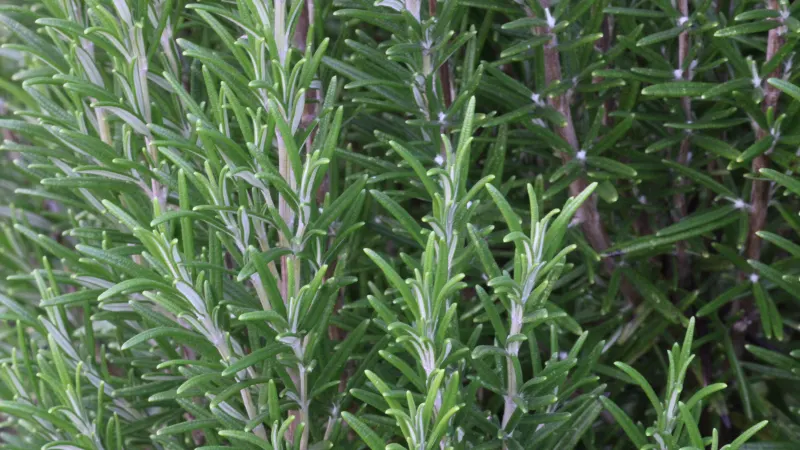
The RHS describes a bushy shrub, prostrate to upright and 15 cm to 2 m tall, with narrow, dark green leaves 1.5–5 cm long and pale, felty undersides. NC State puts a typical upright plant at about 1.2–1.5 m. The small two-lipped flowers are usually pale violet-blue or white, sometimes pinkish or blue-purple, and the RHS says they open from mid-spring to summer, with a few in autumn. NC State notes that they attract bees and butterflies.
How cold it can take, and where it should spend the winter
Rosemary is hardy in the ground across most of the UK, and more vulnerable in a pot. The RHS rates it H4, hardy through most of the UK, at about -10 to -5°C. On its growing page it says established plants can survive about -8°C, though harsh frosts and cold winds can damage them, and in extreme cases kill them. In US terms, NC State Extension gives USDA zones 8a to 10b, and Illinois Extension notes that it is not reliably hardy in zone 6 or colder.
A pot changes the picture. The RHS warns that prolonged cold can freeze the compost and roots in a container, and that cold, wet compost can rot them. Its advice for pots kept outside is to group them together, wrap them in old blankets or bubble wrap, or move them somewhere sheltered such as a porch, a greenhouse or the lee of a wall. In a wet winter, move potted plants into a rain shadow beside a building.
So there are two reasonable winters for a potted rosemary. In a mild garden it can stay outside, protected from freezing and from winter wet. Where winters are harder, or if you want it close at hand, bring it indoors. Wisconsin Extension, writing for a cold climate, says to bring it in before the first frost, and Penn State Extension suggests two to three weeks before. The method is in when to bring plants inside for autumn, and how to debug plants before bringing them inside covers the pests that ride in with them.
Plan for this from the start. Illinois Extension notes that rosemary does not transplant well from the garden into a container, and recommends keeping it in a pot if it will move indoors. Wisconsin suggests that a plant you put in the ground for the summer should be repotted two to three weeks before the first autumn frost.
Why rosemary dies indoors: overwatering and low light
Rosemary is hard to keep indoors over winter: NC State Extension notes that it can be difficult to overwinter indoors, and the sources agree on why. Wisconsin Extension says the biggest cause of decline and death is overwatering. NC State Extension says the same: it is drought tolerant, does poorly in wet, humid conditions, and overwatering is the most common cause of decline or death. Penn State Extension warns that overwatering can be fatal, especially for potted plants overwintered indoors, and that browning tips can signal root rot.
The trap is that rosemary looks thirsty indoors. Illinois Extension explains that it dries out quickly in a heated room, which leads to brown leaf tips and dieback, and then adds the important part: this does not mean it needs more water, because more water leads to root rot and the loss of the plant. Brown tips on an indoor rosemary can mean dry air, as Illinois says, or root rot, as Penn State warns; neither is cured by more water.
Low light makes it worse. In the dim months, Illinois notes, rosemary grows little. Penn State sums up what makes indoor overwintering difficult: low light and incorrect watering, too much or too little.
How to water, then. Penn State Extension groups rosemary with the herbs that should dry out slightly between waterings, and Illinois says to water sparingly and keep the soil on the dry side. Wisconsin's Kenosha County office suggests checking the compost once or twice a week by pushing a finger about 2.5 cm into it, and watering thoroughly only if it feels dry. Use a pot with drainage holes, empty the saucer after watering, and take off any decorative foil sleeve, which Kenosha suggests removing to prevent waterlogging. Penn State recommends clay pots for overwintering because they dry faster. The general method is in overwatering vs underwatering.
A model of the individual plant helps here. Botanical Legacy keeps a Digital Shadow of each Specimen in your Sanctuary, a running estimate of when that particular pot will be dry. On every plan, including the free one, you can log a quick soil check from the Specimen's page, from bone dry to wet. After three checks between waterings, the model starts correcting its drying rate for that plant from what you found. For a rosemary that moves between a summer patio and a winter windowsill, that means a timing fitted to this pot where it stands now.
Light: full sun outside, every scrap of it inside
Outdoors, rosemary wants full sun. The RHS asks for a warm, sunny spot, and NC State Extension defines full sun as six or more hours of direct sun a day. The RHS plant entry suggests a sheltered, south- or west-facing aspect.
Indoors, light is the hard part. Penn State Extension lists rosemary among the herbs that do best in direct sunlight, and suggests a south-facing window or fluorescent lights 15–30 cm above the plant. Iowa State Extension calls light often the most limiting factor for herbs indoors, and notes that rosemary may need supplemental light from a full-spectrum LED or fluorescent grow light, run on a timer for 12 to 16 hours a day. Kenosha County Extension suggests turning the pot weekly so every side gets light.
If you use Botanical Legacy, the place you put a Specimen in carries the light you described for it, as a level or as the window's direction. When a plant's light needs and its place don't match, the app flags it and names a better place you already have. Moving it to the brightest cool spot in the house is still your job.
Temperature and humidity indoors
Rosemary wants a cool winter indoors, not a warm one. Illinois Extension suggests a cool, even cold, sunny spot, and its gardening blog gives about 10–16°C with very bright sun. Kenosha County Extension suggests a bright spot that does not go above about 18°C, with the radiator or heat register well away from the plant. A sunny, unheated room, a cool landing or a bright porch that stays above freezing all suit it better than a warm living room. Kenosha also mentions a garage, as long as it stays above freezing and gets enough light, and the Illinois blog's author reports a neighbour's success on a partially heated porch with plenty of light.
Heated air is very dry, and Illinois Extension notes that homes are usually too warm and too dry for rosemary. It suggests standing the pot on a saucer of pebbles and water, and misting it often; Kenosha suggests misting once a week or using a humidifier. Do not confuse humid air with wet compost: the pebble tray raises the humidity around the leaves, while the roots still need to dry between waterings. Keep air moving, too, as Penn State advises, because still, humid air brings powdery mildew.
Rosemary needs no feeding over winter, Kenosha notes. Move it back outside in spring once the danger of frost has passed, as Penn State and Kenosha both advise, and Kenosha suggests repotting into fresh compost at the same time.
On the paid plan, Botanical Legacy can watch the nights around that move for you. With local weather turned on, your location set and weather alerts on, a Specimen in a place you have marked as outdoor is checked against your local forecast. When the forecast low comes within 2°C of that plant's recorded minimum temperature and stays there for two hours or more, you get a frost alert that names the plant. A night that comes close without passing the plant's own limit is reported if it is unusually cold for the time of year, or if the plant has had no frost alert for a month. A Specimen with no recorded minimum is guarded as a tender plant. The alert cannot see the fleece or the porch, so it tells you when to act, not whether you already have.
Pot, compost and feeding
Drainage matters more than anything else in the pot. The RHS recommends a container at least 30 cm wide and deep with plenty of drainage holes, filled with peat-free, soil-based compost mixed with up to 25% horticultural grit by volume. It notes that rosemary dislikes wet roots, especially in winter. Penn State Extension describes the soil it prefers as light, well-drained and sandy or gravelly, and says it does poorly in wet or poorly drained clay.
It needs little food. The RHS says rosemary in the ground needs no feeding and does well even in poor soil, and that a plant that has been in the same container for more than a year benefits from a sprinkling of general-purpose granular feed in late spring or early summer. Wisconsin Extension advises fertilising potted plants lightly.
Pruning and harvesting
Rosemary is evergreen, so the RHS says it can be harvested all year, by snipping shoots as needed with the plant's shape in mind. Wisconsin Extension advises taking small amounts and removing no more than 20% of the growth at a time.
For shape, the RHS recommends a light trim every year after flowering to keep the plant compact and bushy, and warns against cutting back into old wood. Unpruned plants become leggy, woody and bare at the base, and old, straggly plants do not usually recover from hard pruning. The RHS suggests replacing them, and gives a rough lifespan of seven or eight years before that is due. Wisconsin adds that you should avoid cutting into woody stems unless you are shaping the plant.
Propagation
Illinois Extension notes that rosemary is best propagated from stem cuttings, which is also the easy way to replace an old plant. The RHS suggests softwood cuttings from new growth in late spring or summer, or semi-ripe cuttings in summer. Wisconsin Extension recommends 10–15 cm tip cuttings from a shoot that is not flowering, taken from late spring to early summer, with the lower leaves stripped, rooted in a medium such as perlite. Penn State Extension takes a 15 cm stem tip, dips the base in rooting hormone and roots it in a sterile, well-aerated mix with bottom heat of about 21–24°C, and finds cuttings root in 10 to 20 days.
The RHS also describes layering: peg a low stem into the soil in spring or autumn and let it root, then pot it up. Seed is possible but slow. Wisconsin says germination is slow and irregular, and Penn State notes that named cultivars do not come true from seed. More on the method is in the guide to propagating plants.
Common problems
Brown tips and dieback indoors. Dry heated air or rotting roots, rarely thirst. Illinois Extension links brown tips and dieback to rosemary drying out in indoor air, and Penn State to root rot. Feel the compost before you water: if it is damp, the roots are the problem, so let it dry. Raise the humidity around the leaves with a pebble tray.
Sudden collapse in winter. Usually root rot from overwatering, which Wisconsin and NC State Extension both name as the most common cause of decline and death. Penn State names low light alongside incorrect watering as what makes overwintering difficult.
White powder on the leaves. Powdery mildew. Penn State Extension says rosemary is prone to it and advises keeping air moving between plants, and NC State links it to poor air circulation and high humidity. The RHS lists powdery mildews among rosemary's diseases.
Grey mould and root rots. Wisconsin Extension names root rot and botrytis as the most common diseases, and the RHS lists foot and root rots. Good drainage and good air movement prevent both.
Pests indoors. NC State Extension lists aphids, mealybugs, whiteflies and spider mites, especially indoors, and Penn State adds thrips. Wisconsin Extension and the RHS also name scale insects. Check under the leaves when you bring it in and while it is indoors. A photo to the Doctor, powered by Botanical Vision v5, returns a health verdict, the likely cause of what it sees, and what to do. The guide to common houseplant pests covers identification and treatment.
Rosemary beetle. Outdoors in the UK, the RHS describes rosemary beetle as a shiny beetle 6–7 mm long with metallic purple and green stripes, and greyish-white larvae up to about 8 mm. Adults and larvae eat the leaves, and are most active from August to April. The RHS notes that the plant's health is not usually seriously affected and that control is usually unnecessary; you can tap the branches over newspaper to collect them.
Pale mottling and froth. The RHS links coarse pale mottling in spring and summer to sage and Ligurian leafhoppers, and notes that the froth of cuckoo spit is made by harmless froghopper nymphs.
Xylella. The RHS considers rosemary a high-risk host for the bacterial disease Xylella fastidiosa, and suggests buying British-grown plants to reduce the risk of importing it.
Frequently asked questions
Why is my rosemary dying indoors?
Almost always overwatering in low light. Wisconsin and NC State Extension both name overwatering as the most common cause of decline and death, and Penn State adds low winter light. Brown tips indoors tempt you to water more, but Illinois Extension warns that this leads to root rot. Give it the brightest, coolest spot you have, let the compost dry slightly between waterings, and raise the humidity with a pebble tray instead.
How often should I water rosemary indoors?
There is no fixed interval. Kenosha County Extension suggests checking once or twice a week with a finger pushed about 2.5 cm into the compost, and watering thoroughly only if it is dry. Penn State Extension says rosemary should dry out slightly between waterings. Use a pot with drainage holes and never leave it standing in water.
Can rosemary stay outside in winter?
In much of the UK, yes. The RHS rates it H4, hardy to about -10 to -5°C, and says established plants survive about -8°C. In a pot, protect it from freezing and from winter wet by grouping, wrapping or moving it to a sheltered spot. Where winters are colder, bring it indoors before the first frost.
Is rosemary now called Salvia?
Yes. The RHS lists it as Salvia rosmarinus and notes that the genus has changed from Rosmarinus to Salvia. NC State Extension and University of Wisconsin Extension give Rosmarinus officinalis as its former name. The plant is the same, and the old name is still common on labels.
Is rosemary toxic to cats and dogs?
No. The ASPCA lists rosemary as non-toxic to dogs, cats and horses. The RHS does list it as a skin allergen and advises wearing gloves when handling it, so wear them if your skin reacts to it.
Can Botanical Legacy help me keep a rosemary through winter?
It helps with the part that kills most of them, the watering. Each Specimen gets its own Digital Shadow, an estimate of when its pot will be dry, and soil checks you log on any plan teach the model that plant's real drying rate, wherever the pot stands. The place you set it in carries the light you described, and the app flags a mismatch and names a better place you already have. On the paid plan, with local weather and weather alerts on, a rosemary in a place marked as outdoor gets frost alerts by name.
Start your sanctuary
Botanical Legacy's free Observer plan covers up to five Specimens, each with its own continuously running Digital Shadow and soil checks that teach it each pot's drying rate. A rosemary, which needs regular water in a pot on a hot patio and rots when the same routine follows it indoors, is exactly the kind of plant a steady per-pot model is for. Every new account also includes a 14-day trial of Cultivator, the paid plan, which adds the local weather feed and soil sensor support.
START YOUR SANCTUARY - FIVE FREE SPECIMENS, NO PAYMENT REQUIRED →
Give rosemary sun, sharp drainage and a dry, cool winter, and it outlasts the watering can.
Sources
13 references
The plant-care facts on this page were checked against these references.
- RHS: rhs.org.uk/plants/384211/salvia-rosmarinus-ro/details
- NC State Extension: plants.ces.ncsu.edu/plants/salvia-rosmarinus
- University of Wisconsin Extension: hort.extension.wisc.edu/articles/rosemary
- RHS: growing rosemary: rhs.org.uk/herbs/rosemary/grow-your-own
- Illinois Extension: extension.illinois.edu/herbs/rosemary
- Penn State Extension: extension.psu.edu/herb-garden-plants-rosemary
- Illinois Extension: popular herbs: extension.illinois.edu/blogs/good-growing/2020-05-15-how-grow-p…
- Penn State Extension: herbs indoors: extension.psu.edu/growing-herbs-indoors
- Kenosha County Extension: kenosha.extension.wisc.edu/2020/12/13/holiday-rosemary
- Iowa State Extension: herbs indoors: yardandgarden.extension.iastate.edu/faq/can-i-grow-herbs-indoor…
- Illinois Extension: garden scoop: extension.illinois.edu/blogs/garden-scoop/2018-10-18-rosemary
- RHS: rosemary beetle: rhs.org.uk/biodiversity/rosemary-beetle
- ASPCA: aspca.org/pet-care/aspca-poison-control/toxic-and-non-toxic-pla…